
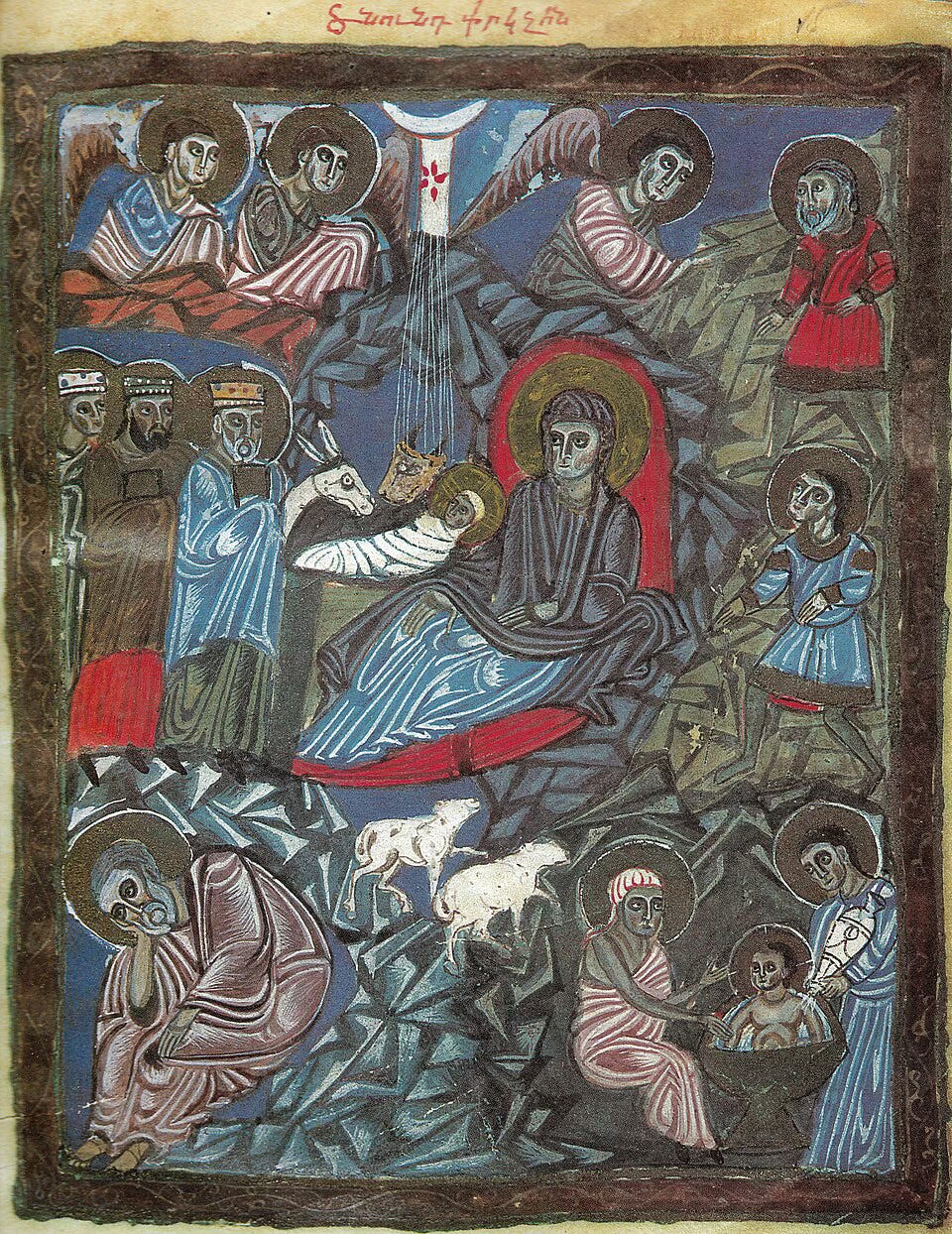

This is a translation of the homily for Epiphany (year III), held in Uskedal Church in Kvinnherad, Norway, Sunday 8th January, 2023. I did not preach at any services this previous Sunday, so I have decided to post an older homily. As I also noted last year, in the Church of Norway we celebrate Epiphany on the nearest Sunday (either before or after the 6th of January). I am not the biggest fan of how this plays out. I have no problem that churches may want to celebrate Epiphany on the nearest Sunday, but the calendar is set up in such a way that they call the nearest Sunday “Epiphany” and call the coming Sunday “the second Sunday of Epiphany.” But that means that the calendar is only in sync with other churches on years where the Sunday falls on the 6th of January or later. This year, like last year, you have the weird consequence that the second Sunday of Epiphany lands on the 11th of January, which almost everywhere else would be the first Sunday of Epiphany.
The readings are as follows: Isaiah 60:1-6; Ephesians 3:1-7; and Matthew 2:1-12. Unless otherwise noted, when quoting Scripture, I will use the Revised Standard Version, Second Catholic Edition (RSV-2CE), corrected to British spelling.
Collect of the day (translated by yours truly):
Let us Pray:
Eternal God, you let the star lead the Magi to Bethlehem. We pray: Be a Light for us on our way. Let all peoples see your glory and praise He who came with salvation, your Son Jesus Christ, our Lord, who with you and the Holy Spirit lives and reigns, one true God, world without end. Amen.
Today we celebrate Epiphany, in Norway also simply called Kristi openberringsdag (“The Revelation of Christ Day”), since “Epiphany” means “revelation” (from Gk. epipháneia), or Heilage tre kongars dag (“Holy Three Kings Day”).
This is one of the oldest feasts of the Church. As far as we know, it was celebrated before we started celebrating Christmas, and marks, among other things, the baptism of Christ, though we usually celebrate that on what we call the second Sunday of Epiphany. The focus is on Christ revealing to us who He is, and today we have read the story of the three Magi. Yes, the text does not say that there were three, but we have assumed that because they gave three gifts; gold, frankincense and myrrh. Tradition has also given these names, Caspar, Melchior and Balthazar, and they have identified them as kings, based on what is written in todays first reading, from the prophet Isaiah (60:3.6):
Nations shall come to your light,
  and kings to the brightness
  of your rising.

A multitude of camels shall cover you,
  the young camels of Mid′ian and Ephah;
  all those from Sheba shall come.
They shall bring gold and frankincense,
  and shall proclaim the praise of the Lord.
And they did so, when they found Christ, first and foremost by bowing down to him. Yes, they were kings, according to tradition, but according to Revelation 19:16, Christ is “King of kings and Lord of lords.” The three Magi came to bow down to wisdom Itself, to God, to their Lord. They expressed this by falling on their knees, by bowing down. But they also expressed this through the gifts they brought, gold, frankincense, and myrrh.
Through the gold they proclaimed that He is Lord and King. Through the incense they proclaimed that He is our high priest who sacrifices himself, and who always intercedes for us. And through the myrrh they proclaimed that He would die, as this ointment was used to embalm the dead. They proclaimed Jesus as King, as Lord, as Priest, and as Saviour, not only for them, but for all. Jesus is the light or star both for those three and for us. And like them, we also have a calling to proclaim Jesus, to proclaim the Word of God. And this has a double meaning. We proclaim God’s message to us, the words God wants us to hear and obey. But it is not the words themselves that are important.
As the Roman Catholic Church teaches in her catechism (§170), and as we should all agree with: “We do not believe in formulae, but in those realities they express, which faith allows us to touch.” We preach precisely the mystery of God, that Christ is saviuor for the whole world, not just those who happened to live in Israel. They came all the way from the East to worship Him and we can also worship Him here, in the cold North. As St. Paul puts it in the second reading of the day:
[T]he mystery was made known to me by revelation, as I have written briefly. When you read this you can perceive my insight into the mystery of Christ, which was not made known to the sons of men in other generations as it has now been revealed to his holy apostles and prophets by the Spirit; that is, how the Gentiles are fellow heirs, members of the same body, and partakers of the promise in Christ Jesus through the gospel. Of this gospel I was made a minister according to the gift of God’s grace which was given me by the working of his power.
Yes, Jesus is the saviour of the whole world, the light of the whole world. And when we talk about a mystery, it does not mean something weird, but something that God has revealed to us, something that we ourselves have not created or invented. It must be grasped in faith. And what he has revealed is precisely the message of Christmas, that God has come down to us. And therefore today, as the rest of Christmas, I listen to a wonderful rendition of O Magnum Mysterium, composed by Morten Lauridsen, performed by Grex Vocalis. The text belongs to Matins on Christmas, and it denotes the great mystery, that God was made flesh, made man, and that He revealed Himself to us:
O great mystery,
and wonderful sacrament,
that animals should see the newborn Lord,
lying in a manger!
O blessed virgin, whose womb
was worthy to bear
the Lord Jesus Christ.
Alleluia!
So listen to it. Yes, the twelve days of Christmas ended yesterday, but the Christmas season extends to Candlemas, 2nd February, when we commemorate Christ’s presentation in the Temple.1 And as its name suggests, the emphasis today is on who Jesus is, on how He has revealed Himself to us. For today is the day of Christ’s revelation. Today it is revealed to us that the Word became man, that God became one of us. And therefore we preach Christ, who is our Saviour and Lord. For this is what the gospel is. When Jesus said, “Repent and believe in the gospel,” and when Paul said that he preached “the gospel of God,” this was not just a vague expression for “good news.” No, the word gospel was an established expression in the Greco-Roman world, including in Israel.
When an emperor came to power, he proclaimed a “gospel”: “Augustus is lord. Now there will be peace and order.” But often it was just empty rhetoric; the emperor cared about you as long as you could pay taxes. But in Jesus, we see something different. Here we find the righteous King, the good Prince, the Prince of Peace as it is called in Isaiah, in a text we often hear at Christmas (Isaiah 9:2.6):2
The people that walked in darkness
    have seen a great light:
they that dwell in the land
    of the shadow of death,
    upon them hath the light shined.

For unto us a child is born,
    unto us a son is given:
and the government shall be
    upon his shoulder:
    and his name shall be called
Wonderful, Counsellor, The mighty God,
    The everlasting Father,
    The Prince of Peace.
Yes, the light shines forth from Jesus, who is the Light of the World. He is the King of kings, He who can rightfully proclaim the good news. The gospel is that it is Christ, God and man, who is Lord and King, not Herod, Caesar, Augustus, Napoleon, Haakon, Olav or Harald. Or, as St. Paul put it in 1 Timothy 6:13-16:
In the presence of God who gives life to all things, and of Christ Jesus who in his testimony before Pontius Pilate made the good confession, I charge you to keep the commandment unstained and free from reproach until the appearing of our Lord Jesus Christ; and this will be made manifest at the proper time
    by the blessed and only Sovereign,
    the King of kings and Lord of lords,
    who alone has immortality
    and dwells in unapproachable light,
    whom no man has ever seen
    or can see.
    To him be honour
    and eternal dominion.
    Amen.
That is what we celebrate today, that the immortal God became one of us, so that we could be lifted up to salvation and eternal life. So let us always honour, thank and praise God, let us bow down to Him who is our King.
Glory be to the Father and to the Son and to the Holy Spirit, who was, is, and will remain, one true God, world without end. Amen.
This is an old tradition. My justification for it is that this follows the infancy narrative in the Gospel of Luke, chapter 2, which starts with Sts. Mary and Joseph going to Betlehem and ends with them presenting Christ in the temple on His 40th day.
Here in the familiar tongue of the Authorised (King James) Version.